The Collapse of the Canvas: How Claude Opus 4.7 and Claude Design are Rewiring Product Development
The friction between a raw idea and a shipped product has never been thinner. With Anthropic's back-to-back releases of Claude Opus 4.7 and Claude Design this week, we are no longer just talking about conversational AI or incremental code generation. We are looking at a fundamental rewiring of the product development lifecycle. The landscape has shifted from AI as an interactive assistant to AI as an autonomous, multi-disciplinary partner.
As a Software Development Engineer transitioning into Product Management, these updates are not just feature drops to me. They represent a total compression of the time it takes to validate, design, and build.
The Autonomous Engine: Claude Opus 4.7
The whisper in the developer community has been that AI models hit a wall on long-horizon, complex tasks. Opus 4.7 shatters that ceiling. It is a striking evolution in advanced software engineering, designed specifically to handle the hardest, most brittle tasks that previously required intense human supervision.
What makes Opus 4.7 remarkable isn't just raw intelligence; it's the reliability of its execution. With the introduction of the new "xhigh" effort control, the model effectively leans forward, trading a bit of latency for much deeper reasoning on complex architectures. It catches its own logical faults during the planning phase, remembers critical context across multi-session file system work, and pushes through tool failures that would have derailed older agents.
Coupled with vastly improved multimodal vision (now capable of parsing high-resolution technical diagrams and ~3.75-megapixel images), Opus 4.7 acts less like a junior developer and more like a seasoned technical lead who pushes back on bad decisions and writes self-verifying code.
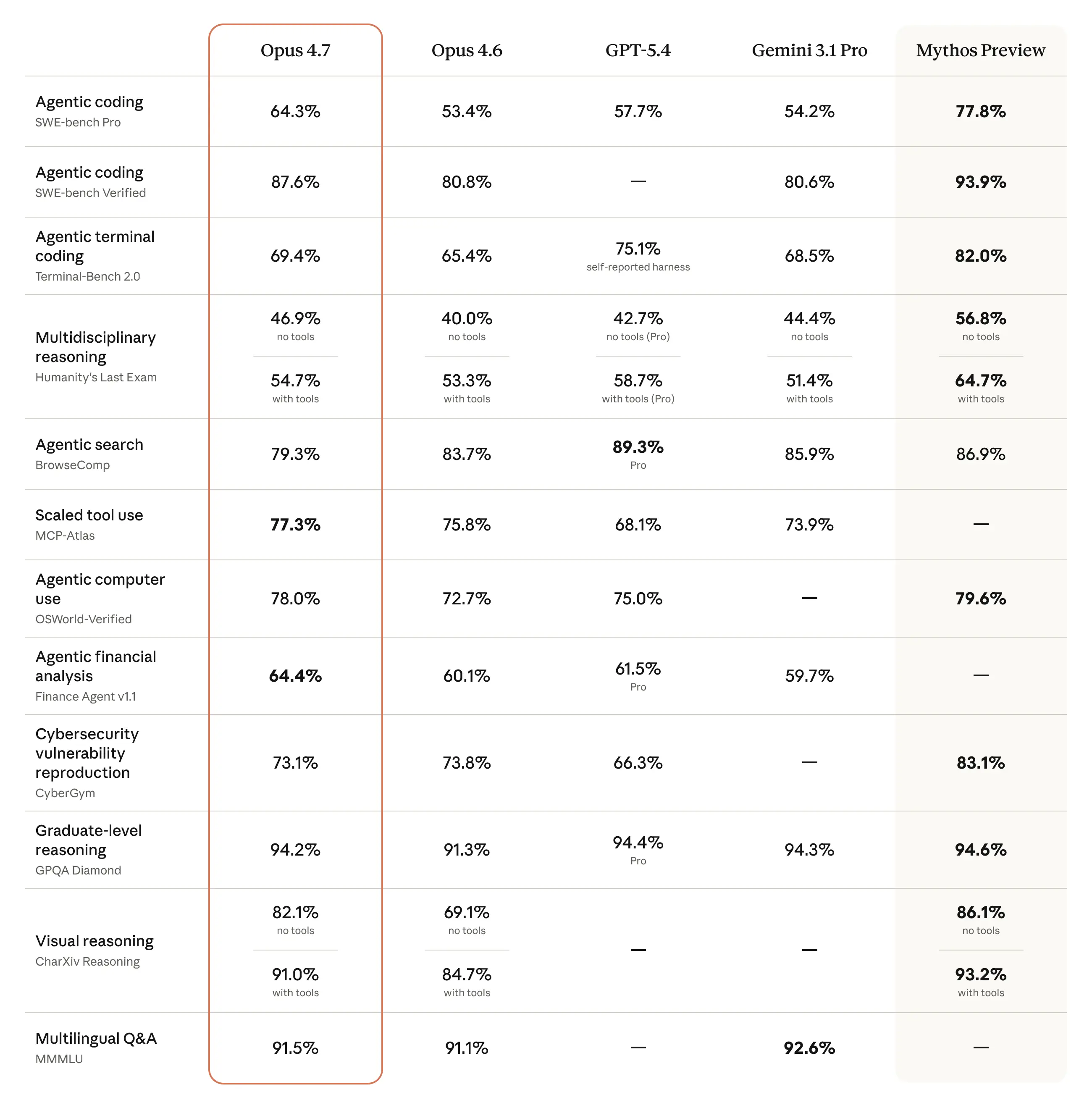
The numbers back up the feel. On SWE-bench Pro, the benchmark that measures real-world issue resolution against open-source repositories, Opus 4.7 lands at 64.3%, up from 53.4% on Opus 4.6 and ahead of GPT-5.4 at 57.7% and Gemini 3.1 Pro at 54.2%. CursorBench, which is closer to how most of us actually use these models day-to-day inside an editor, jumps to 70% from 58%. Anthropic also reports a 14% improvement on complex multi-step workflows while using fewer tokens and producing roughly a third of the tool errors of its predecessor. It is the first Claude model to pass what the company calls "implicit-need tests," tasks where the model has to infer which tools to reach for rather than being handed a script.
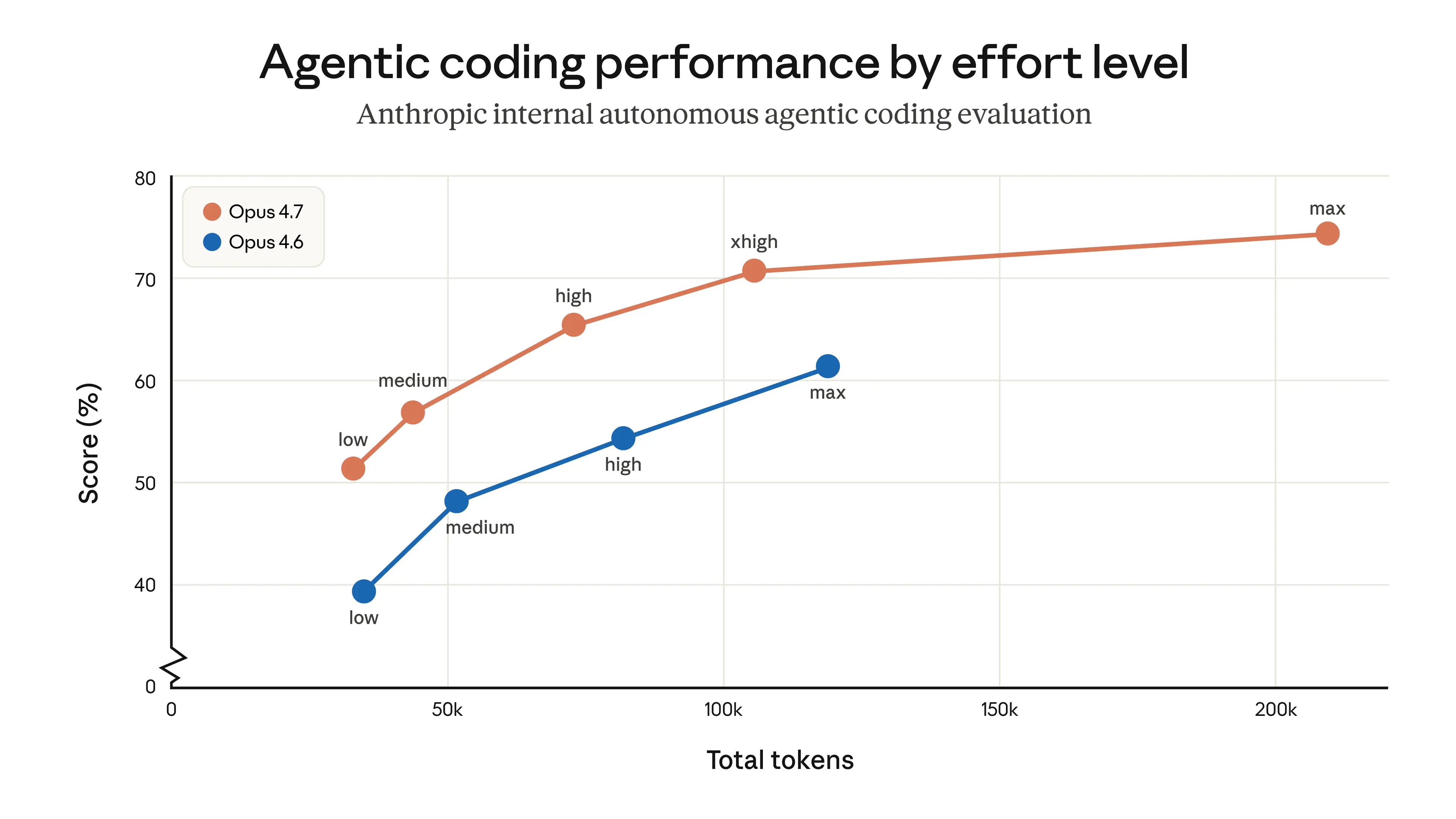
The gains aren't confined to a single eval, either. Across the evaluation suite Anthropic published, Opus 4.7 posts meaningful jumps over 4.6 on the tasks that matter most for real engineering work: long-running agent traces, vision-heavy reasoning (now at 2,576 pixels on the long edge, 3x the resolution of prior Claude models), and tool-use recovery. Paired with a 1M-token context window and what evaluators described as the most consistent long-context performance of any model tested, the result is a model that stays coherent across the kind of hours-long workflows that used to quietly drift.
Task Budgets and a Crowded Rollout
Two details in the release notes deserve more attention than they're getting. The first is task budgets, a new beta capability where you hand Claude a rough token allowance for an entire agentic loop (thinking, tool calls, tool results, and final output combined) and the model self-moderates against a running countdown. It isn't a hard cap like max_tokens; it's a signal the model can actually see and reason about, so it can scope work, cut the nice-to-haves, and wrap up gracefully as the budget drains. For anyone who has watched an agent burn through an hour of compute chasing a side quest, this is a quiet but important shift in how autonomy is governed.
The second is just how fast the rollout is moving. Opus 4.7 is available from day one in Cursor, Claude Code, GitHub Copilot (Pro+, Business, and Enterprise), Amazon Bedrock, Google Vertex AI, and Microsoft Foundry. Anthropic has kept API pricing flat against Opus 4.6, though a few of the IDE partners are still working out how to meter the deeper reasoning passes; Cursor launched with a promotional discount, and there has been plenty of debate on GitHub about Copilot's initial 7.5x multiplier even after its own 50% introductory promotion. That tension, between Anthropic holding the line on price and tooling partners trying to absorb the cost of "xhigh," is going to be one of the more interesting sub-plots of this release cycle.
It's also worth remembering the why. The weeks leading up to 4.7 were full of developer posts claiming Opus 4.6 had quietly regressed, including a widely shared note from an AMD senior director saying Claude "cannot be trusted to perform complex engineering." Anthropic didn't frame 4.7 as a response to that discontent, but it's hard to read the emphasis on reliability, tool-error rates, and long-horizon coherence as coincidence. The bar for frontier models is no longer "is it smart?" but "does it stay smart for eight hours straight?"
Bridging the Visual Divide: Claude Design
But writing robust backend logic is only half the battle. The true bottleneck for product managers and founders has always been the translation of strategic intent into tangible, user-tested interfaces. Enter Claude Design.
Powered by Opus 4.7's upgraded vision capabilities, Claude Design completely collapses the barrier between a product requirements document and an interactive prototype. By simply pointing the model at your existing codebase or design files, it instantly builds a custom design system, ensuring every new wireframe, slide deck, or landing page it generates is perfectly on-brand.
This is a seismic shift for cross-functional collaboration. Instead of rationing design explorations, you can generate a dozen distinct aesthetic directions in a single meeting. You can tweak spacing with custom sliders, comment inline, and directly export the polished asset to Canva, PPTX, or hand it off as a complete code bundle to Claude Code. The days of getting lost in translation between the PM brief, the Figma board, and the engineering sprint are ending. We are moving toward a unified, continuous flow of creation.
The Frontier Edge: Mythos and Project Glasswing
While Opus 4.7 is redefining product execution, it is actually the precursor to an even more powerful, albeit restricted, frontier. Lurking behind these commercial releases is Claude Mythos Preview, a model with capabilities so advanced it surpasses most humans in identifying and exploiting critical software vulnerabilities.
The stark reality is that AI has reached a tipping point in cybersecurity, capable of unearthing zero-day flaws that have evaded human review for decades. To prevent these capabilities from being weaponized, Anthropic spearheaded Project Glasswing, an alliance with tech giants like AWS, Google, and Microsoft, to deploy Mythos Preview strictly for defensive infrastructure hardening. Opus 4.7, running with advanced safeguards informed by this research, serves as the commercial bridge, delivering immense utility while the industry prepares for the reality of Mythos-class models.
The New Baseline
As we look at the trajectory from code generation to autonomous problem-solving and full-stack design generation, the role of the Product Manager is changing. The premium is no longer on managing the execution pipeline, but on possessing the strategic clarity, taste, and vision to guide these deeply capable systems.
Opus 4.7 and Claude Design aren't just tools; they are the new programmable foundation for the next generation of intelligent products.
Where This Leaves Us
For the last decade, shipping software has been an exercise in managing handoffs. The PM brief becomes a Figma file, which becomes a Jira ticket, which becomes a pull request, which becomes a regression. Each handoff leaks intent. What Opus 4.7 and Claude Design really collapse is not just time, but that leakage. The canvas, the codebase, and the spec are starting to behave like a single living document.
The uncomfortable implication is that the bottleneck in product development is no longer capacity; it's conviction. When a team of one can prototype ten directions before lunch, the differentiator isn't how fast you can build, but whether you know what's worth building. Taste, judgment, and the discipline to say no become the scarce resources.
I don't think this is the moment where PMs or engineers are replaced. I think it's the moment where the mediocre middle of both crafts quietly disappears, and the people who remain are the ones who can hold a strong point of view and steer a very capable system toward it.
If you're building with these tools, or wrestling with what they mean for your role, I'd love to trade notes. Let's connect on LinkedIn.