Vritto
A private, connected place for your whole life

A private personal organizer connecting plans, people, records, and routines across web, iPhone, and Android, with focused tools for each part of life and optional AI.
I'm building Vritto, a private personal organizer that connects your plans, people, records, and routines across web, iPhone, and Android. It brings together the parts of life that usually sit in separate apps, with focused tools for each area and connections that make information useful beyond the place it was entered.
As founder, I lead product, design, engineering, and AI. My work spans how each part of life is organized, how information connects, and what assistants are allowed to see and change.
The Product Bet
Most personal software understands only one slice of a person. A calendar knows time. A finance app knows transactions. A contact app knows names. A health app knows measurements. The user still has to connect those facts and coordinate what happens next.
Flexible workspaces solve a different problem, but they often begin with a blank canvas. Users have to design databases, properties, views, and conventions before the system becomes useful. That flexibility creates its own maintenance burden and still leaves every category represented as a generic page.
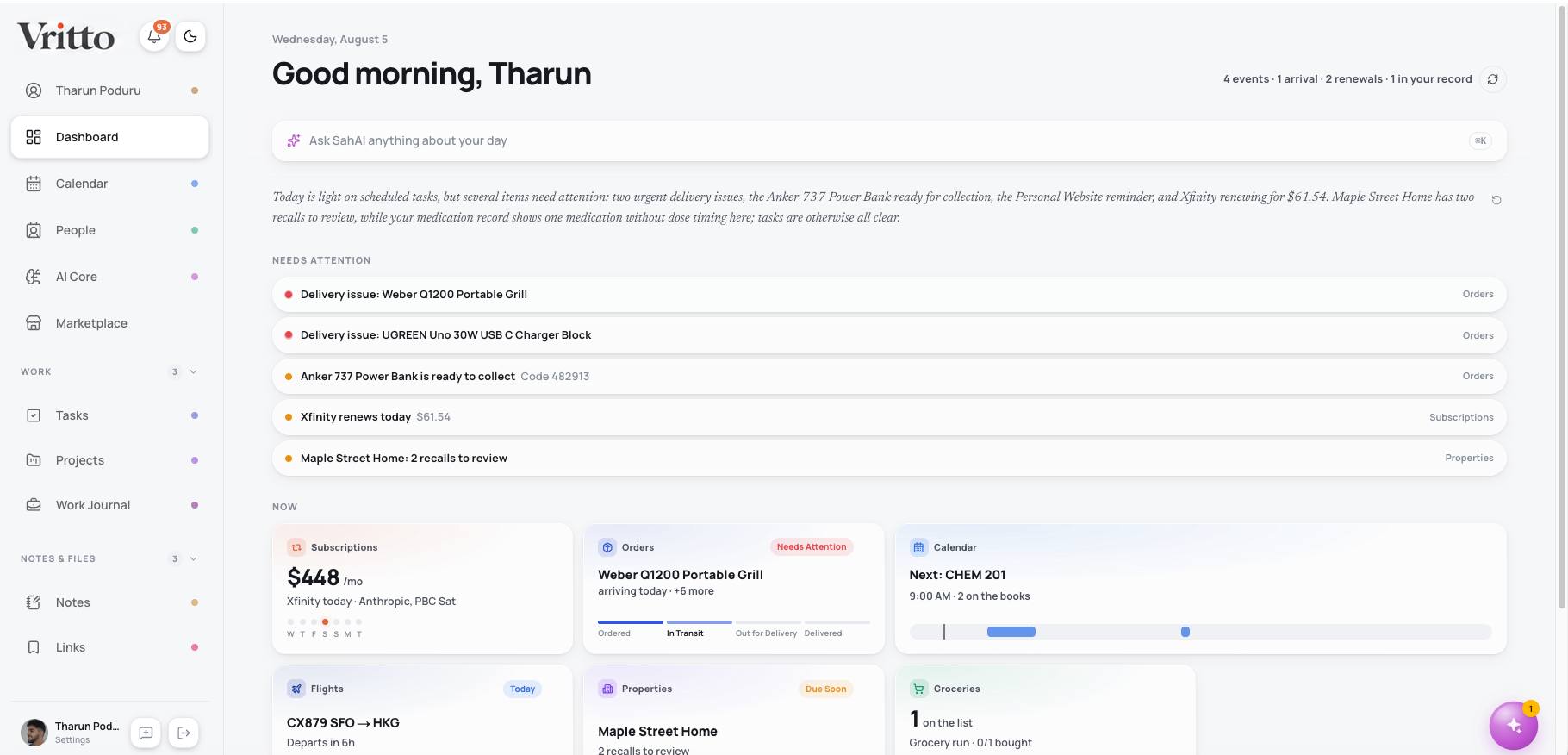
Vritto takes a more opinionated approach: structure each area according to what it represents, then connect those areas through one private record. A subscription behaves like a subscription. A trip has legs, stays, places, and plans. A person can be connected to dinners, gifts, memories, and future commitments without being duplicated across them.
Connected by Design
Each area in Vritto has the fields, views, and actions its subject needs. Orders track deliveries and returns. Trips bring flights, stays, and plans together. People connect to birthdays, gifts, and shared experiences. The same person, place, or record can appear wherever it is relevant without being entered again.
That distinction shapes the product in three ways:
- Focused on its own. Orders can model shipments, pickup windows, returns, refunds, merchants, and spending without forcing that structure onto unrelated records.
- More useful together. A dinner can connect a person, reservation, place, task, and planned spend. A trip can collect flights, stays, packing, dining, and memories around one experience.
- Readable without AI. Modules, dashboards, reports, and relationships remain useful on their own. Intelligence is a capability layered on top, not a dependency for understanding the user's data.
Intelligence with Boundaries
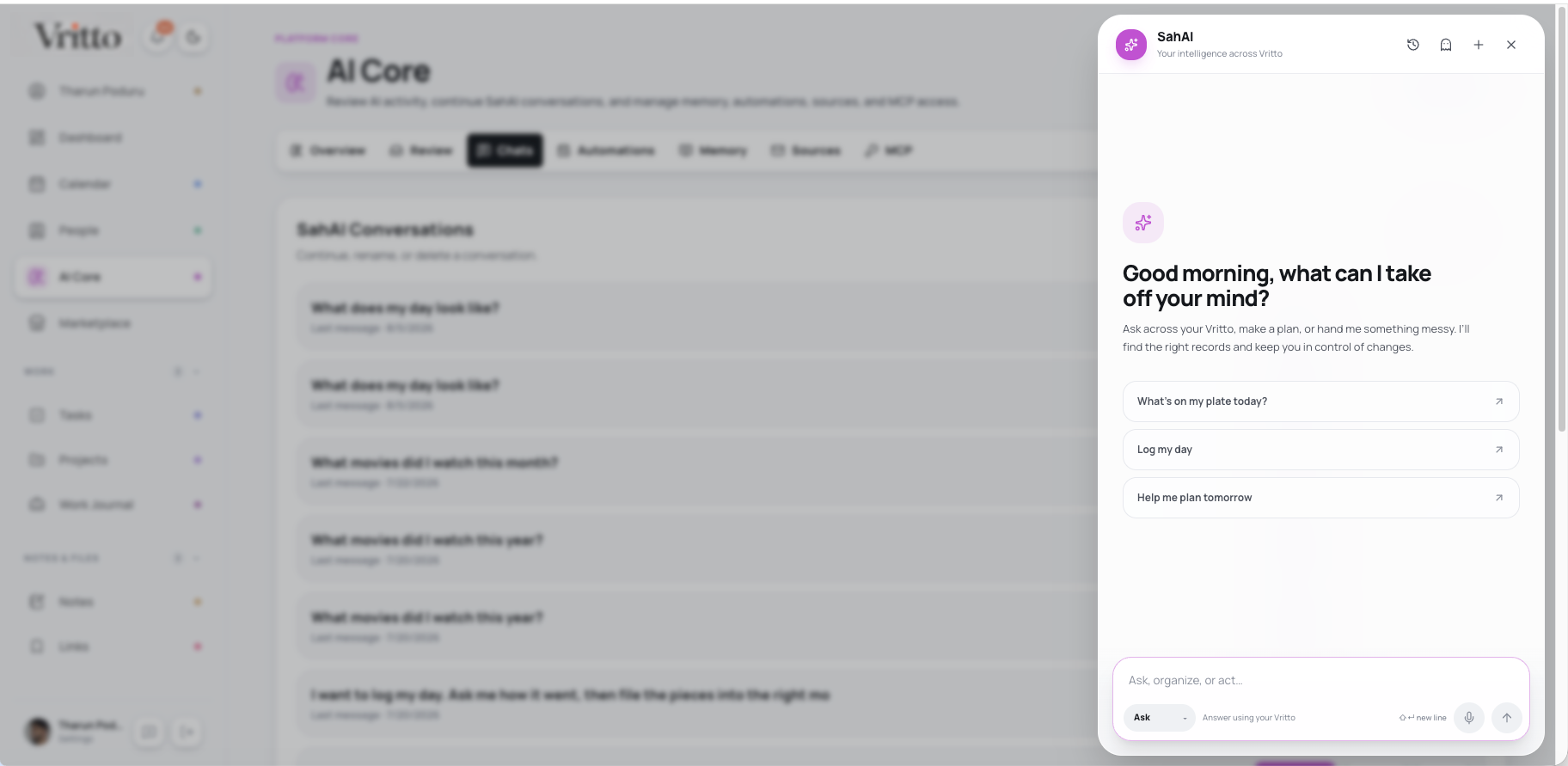
SahAI is Vritto's built-in assistant. It can answer questions across permitted records, prepare a brief for the day, and help add or update information. Users control its access and whether changes require review.
External assistants can connect through the Model Context Protocol. Users choose which supported modules each assistant can access and whether it can make changes. Sensitive areas remain unavailable unless enabled, and access can be revoked from Vritto.
This creates a deliberate separation between the record and the intelligence. The data lives in Vritto. The user can choose whether intelligence comes from SahAI, an external assistant, or nowhere at all.
Across Web, iPhone, and Android
Vritto uses a shared backend across its web, iPhone, and Android apps. Records and permissions follow the same rules on every platform, while navigation and interactions are designed for each device.
The native apps are built in SwiftUI and Jetpack Compose. They include module workflows, account and subscription flows, notifications, and device integrations. Android builds are on the internal testing track, and release preparation includes checking real workflows on devices alongside automated coverage checks.
Building across three platforms makes consistency a product responsibility. A feature needs to carry the same meaning, permissions, and useful information from one device to another, even when the interaction differs.
From Project to Company
Vritto began as software I wanted for myself: one trustworthy place for a life spread across too many applications. Building the first modules exposed a larger product opportunity. The difficult part was not adding more categories; it was defining a system that could hold very different kinds of information without flattening them into generic records or turning the interface into a maze.
That work evolved into Vritto, Inc., founded in 2026. The company is being built around a straightforward promise: make useful subscription software, keep incentives aligned with the people using it, and treat privacy and user control as product architecture rather than policy-page language.
This page documents the product decisions and work behind the company. The Vritto website explains the product, plans, and availability.
Current Stage
Built: web and native apps, connected modules, dashboards, notifications, SahAI, controls for external assistants, onboarding, subscription and entitlement flows, and integrations for calendars and automated capture.
Before broader access: continued device testing, release verification, external approvals, and launch preparation. Implementation and automated checks are milestones; they do not replace testing the complete customer experience.
My Role
As founder, I decide what to build, in what order, and how it should work. I design the experience and build across the apps and backend services, including the AI layer and the controls around it.
Three decisions shape that work: give each area of life the structure it needs, connect records without making users maintain those connections by hand, and keep the product useful when AI is turned off. Those choices guide the data model, interface, subscription offering, and release priorities.
My focus now is testing those decisions through complete everyday workflows and preparing Vritto for public launch.